 Add to Chrome
 Add to Firefox
 Add to Edge
When Correct Demonstrations Hurt: Rethinking the Role of Exemplars in In-Context Learning
May 25, 2026
In-context learning (ICL) is often motivated by the intuition that demonstrations help because they provide correct input-output examples. However, we reveal a counterintuitive phenomenon: correctness does not guarantee exemplar utility, and some correct demonstrations can even reduce ICL accuracy. To study this correctness-utility gap, we introduce task-preserving perturbations, where only the exemplar input is changed, while the example remains a correct instance of the same task. Concretely, each perturbed exemplar is assigned the target induced by the task mapping. This framework covers both label-updating perturbations, where task-relevant semantics change and targets are recomputed, and stricter target-preserving perturbations, where the original target remains valid. We formalize the resulting failure mode as contextual evidence shift: task-preserving perturbations can change the effective mixture of evidence used by the model for contextual inference, thereby separating exemplar correctness from exemplar utility. Across sentiment classification, logical reasoning, and math word problems, we find that task-preserving perturbed demonstrations can substantially degrade ICL performance, especially for smaller models, harder tasks, and higher perturbation ratios. Our results show that robust ICL requires evaluating not only whether demonstrations are correct, but also how they influence contextual inference. Code is available at https://github.com/Chenghao-Qiu/Task-Preserving-ICL.

GenoArmory: A Unified Evaluation Framework for Adversarial Attacks on Genomic Foundation Models
May 16, 2025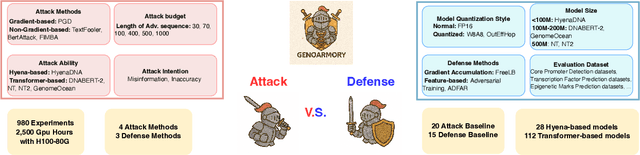
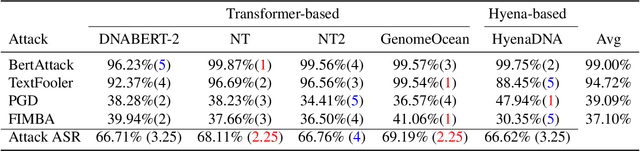
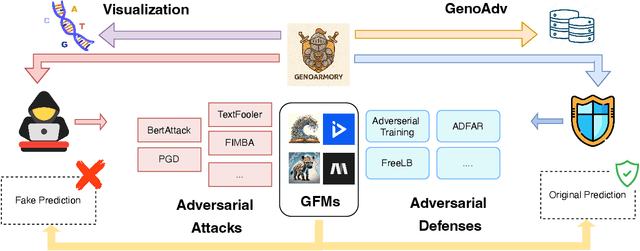

We propose the first unified adversarial attack benchmark for Genomic Foundation Models (GFMs), named GenoArmory. Unlike existing GFM benchmarks, GenoArmory offers the first comprehensive evaluation framework to systematically assess the vulnerability of GFMs to adversarial attacks. Methodologically, we evaluate the adversarial robustness of five state-of-the-art GFMs using four widely adopted attack algorithms and three defense strategies. Importantly, our benchmark provides an accessible and comprehensive framework to analyze GFM vulnerabilities with respect to model architecture, quantization schemes, and training datasets. Additionally, we introduce GenoAdv, a new adversarial sample dataset designed to improve GFM safety. Empirically, classification models exhibit greater robustness to adversarial perturbations compared to generative models, highlighting the impact of task type on model vulnerability. Moreover, adversarial attacks frequently target biologically significant genomic regions, suggesting that these models effectively capture meaningful sequence features.
Fast and Low-Cost Genomic Foundation Models via Outlier Removal
May 01, 2025We propose the first unified adversarial attack benchmark for Genomic Foundation Models (GFMs), named GERM. Unlike existing GFM benchmarks, GERM offers the first comprehensive evaluation framework to systematically assess the vulnerability of GFMs to adversarial attacks. Methodologically, we evaluate the adversarial robustness of five state-of-the-art GFMs using four widely adopted attack algorithms and three defense strategies. Importantly, our benchmark provides an accessible and comprehensive framework to analyze GFM vulnerabilities with respect to model architecture, quantization schemes, and training datasets. Empirically, transformer-based models exhibit greater robustness to adversarial perturbations compared to HyenaDNA, highlighting the impact of architectural design on vulnerability. Moreover, adversarial attacks frequently target biologically significant genomic regions, suggesting that these models effectively capture meaningful sequence features.